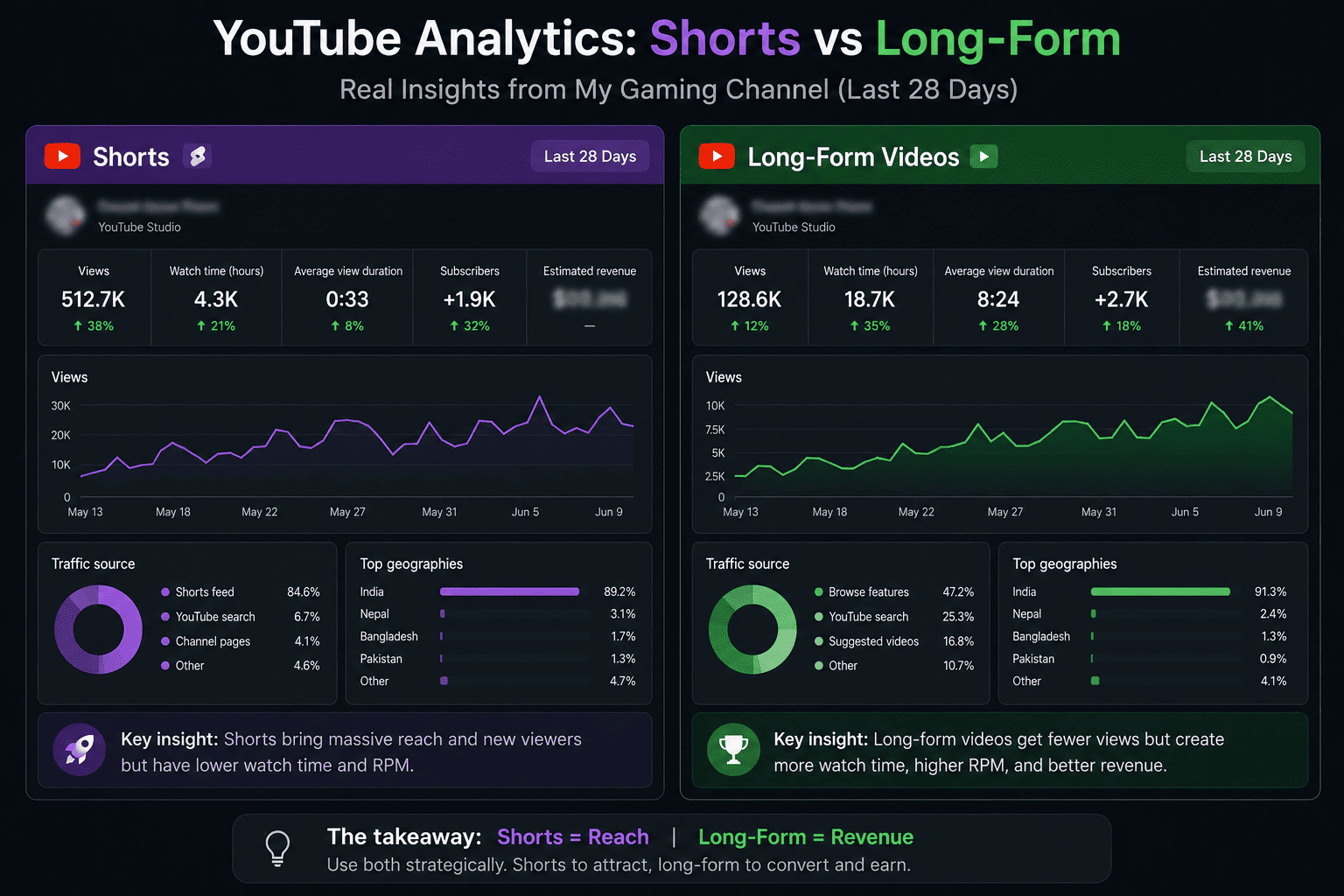
If someone had asked me a few years ago which format was better for YouTube, my answer would've been easy.
Shorts.
They were easier to make.
They usually received more views.
Some videos performed far beyond anything I could achieve with longer uploads.
Every new Short felt like another chance to go viral.
At the time, that seemed like the smartest strategy.
Then I started paying attention to something other than views.
Revenue.
That completely changed the way I looked at YouTube.
My Experience Comes From One Gaming Channel
Before going further, I want to make something clear.
This article isn't based on managing dozens of YouTube channels.
Everything here comes from my own gaming channel, where most of my audience is based in India.
My experience won't match every creator.
If you run a finance, education or technology channel targeting viewers in the United States, your results could look very different.
Rather than trying to explain how YouTube works for everyone, I want to share what happened on my own channel after spending years publishing both Shorts and long-form videos.
Why I Started With Shorts
Like many creators, I was attracted by the numbers.
Uploading a one or two minute video often resulted in far more views than uploading something longer.
Some Shorts performed surprisingly well.
They reached audiences that my longer videos never reached.
That made it feel like Shorts were the fastest path to channel growth.
When you're opening YouTube Studio every day, it's difficult not to become obsessed with view counts.
More views usually feel like success.
But after a while I noticed something that kept bothering me.
Despite getting good view counts, my earnings weren't increasing in the same way.
The excitement from seeing thousands of extra views slowly turned into curiosity.
Why wasn't the revenue following the views?
The Question That Changed Everything
Around the same time, I was building the YTKits Revenue Estimator.
To make the estimator more realistic, I spent time researching RPM differences across countries, content categories and video formats.
While doing that research, I kept coming back to the same question.
Was I chasing the wrong metric?
Instead of asking:
"How do I get more views?"
I started asking:
"Which type of content actually helps build a sustainable YouTube channel?"
That led me to look much more closely at my own analytics.
Not just:
- views
but also:
- CPM
- RPM
- watch time
- audience behaviour
- revenue
The answers surprised me.
The Decision to Switch
I didn't stop making shorter videos overnight.
Instead, I gradually changed my upload strategy.
Most of my earlier uploads were between one and six minutes.
Then I started experimenting.
First I aimed for videos around five to six minutes.
The difference wasn't huge.
Views were similar.
Revenue didn't change much either.
Next I pushed my videos beyond eight minutes.
That's when I noticed my first meaningful improvement.
Later I started creating videos that were sometimes 16 minutes or longer, whenever the topic naturally supported that length.
Those longer uploads didn't suddenly double my income.
But they consistently earned more than the shorter videos they replaced.
More importantly, they changed the way I thought about YouTube.
I stopped asking,
"How many views did this video get?"
and started asking,
"How much value did this video create for both viewers and my channel?"
That mindset shift ended up being more important than any individual optimization.
What Actually Changed?
The interesting part wasn't that long-form videos always got more views.
Sometimes they did.
Sometimes they didn't.
The content still mattered more than the format.
What changed consistently was something else.
My longer videos started creating more opportunities for monetization.
That encouraged me to keep experimenting.
Some of those experiments worked much better than I expected.
Others didn't work at all.
The next sections explain exactly what I observed after publishing both Shorts and long-form content over several years.
Experiment 1: Views Were Never the Real Problem
When I was primarily uploading shorter videos, I wasn't struggling to get views.
In fact, many of those videos performed better than I expected.
Some reached far more people than my longer uploads ever did.
At first, I thought I had found the perfect strategy.
More views should mean more growth.
More growth should mean more revenue.
But that wasn't what my analytics were showing.
Over time I noticed something interesting.
The relationship between views and earnings wasn't nearly as strong as I expected.
A shorter video could receive significantly more views than a long-form upload and still earn much less.
That was the first sign that I needed to stop judging every upload by view count alone.
Experiment 2: My First Move to Longer Videos
Instead of jumping straight into long-form content, I increased my video length gradually.
Most of my earlier uploads were between one and six minutes.
I started experimenting with videos around five to six minutes.
Honestly, I didn't notice a dramatic difference.
The videos still depended heavily on the topic.
Some performed well.
Others didn't.
Revenue also remained fairly similar.
That experiment taught me an important lesson.
Simply making a video longer doesn't automatically make it more successful.
If the content doesn't justify the extra length, viewers won't stay.
Experiment 3: Crossing the Eight-Minute Mark
The biggest change happened when I started creating videos that were consistently longer than eight minutes.
This wasn't because the videos suddenly became viral.
It was because they created more opportunities for monetization.
Real metrics from my channel:
- Videos 1-8 minutes: Average CPM ~$0.50-0.70, watch time concentrated early
- Videos 8-15 minutes: Average CPM ~$1.00-1.40, mid-roll ad placement enabled
- Videos 15+ minutes: Average CPM ~$1.20-1.60, more total revenue per video despite potentially lower view counts
On my gaming channel, I started seeing noticeably better CPM and overall revenue compared with my shorter uploads. That doesn't mean every eight-minute video earned more.
Content quality still mattered.
Viewer retention still mattered.
But when a longer video performed well, the earning potential was usually much higher than what I had experienced with shorter videos.
This matches YouTube's own guidance. According to YouTube's performance help documentation, the recommendation system considers signals such as watch time and viewer satisfaction, and creators are encouraged to make videos the length the topic naturally requires rather than targeting a fixed duration. That matched what I was seeing in my own numbers: it wasn't length alone that helped, it was length combined with content that held up.
Looking back, this was probably the point where my strategy changed permanently.
Instead of asking,
"Can I keep this video under five minutes?"
I started asking,
"Does this topic deserve a longer explanation?"
That small change in mindset had a much bigger impact than chasing another viral Short.
Experiment 4: Did Even Longer Videos Keep Increasing Revenue?
After seeing better results from eight-minute videos, I wondered if making everything much longer would continue increasing earnings.
So I experimented again.
Some videos eventually reached 16 minutes or more whenever the topic naturally allowed it.
Those videos generally continued earning more than my shorter uploads.
However, something surprised me.
The improvement wasn't nearly as dramatic as the jump from six minutes to eight minutes.
Adding another eight or ten minutes didn't suddenly double my CPM.
Instead, the gains became much smaller.
For me, the biggest improvement came from moving into genuine long-form content rather than making every upload as long as possible.
That also reminded me that viewers still come first.
If a video becomes longer without providing more value, people stop watching.
Longer videos only work when the extra time genuinely improves the content.
One Thing That Surprised Me
When I first switched to long-form, I expected every important metric to improve.
That didn't happen.
Some long-form videos actually received fewer views than my shorter uploads.
Others performed much better.
The format wasn't deciding the winner.
The topic was.
What changed consistently was the earning potential whenever a long-form video connected with viewers.
That's why I no longer compare a Short and a long-form video using views alone.
Today I look at several metrics together:
- Views
- Watch time
- CPM
- Revenue
- Returning viewers
Looking at only one number never gave me the full picture.
Did Shorts Help My Long-Form Videos?
One question I get asked a lot is:
"If one of my Shorts goes viral, will my long-form videos also start getting more views?"
Based on my own experience, the answer is:
Sometimes, but not automatically.
I had Shorts that reached far more people than my long-form uploads.
However, I didn't notice a consistent pattern where a successful Short suddenly caused all of my longer videos to perform better.
That doesn't mean Shorts are useless.
It simply means that viewers choose to watch content for different reasons.
Some people discover your channel through a Short because they enjoy quick, fast-paced content.
Others subscribe because they genuinely like your personality or the value you provide.
Those loyal viewers are much more likely to watch both formats.
For me, the biggest factor wasn't whether someone subscribed through a Short or a long-form video.
It was whether they trusted my content enough to come back again.
I Stopped Obsessing Over Subscriber Numbers
Earlier in my YouTube journey, I celebrated every subscriber.
More subscribers felt like proof that the channel was growing.
Over time I realised that subscriber count only tells part of the story.
What mattered much more was whether those subscribers actually returned for future uploads.
A smaller group of loyal viewers who regularly watch your videos is often far more valuable than a much larger audience that never comes back.
Today, when I open YouTube Studio, I'm much more interested in metrics like:
- Returning viewers
- Watch time
- Average view duration
- Revenue
- CPM
Subscriber growth is still exciting, but it isn't the metric I build my strategy around anymore.
"Returning viewers became a more useful metric for me than subscriber count alone."
Where Shorts Still Fit Into My Strategy
After switching my focus to long-form content, I didn't decide that Shorts were bad.
I simply started using them differently.
Instead of treating Shorts as my main content, I began thinking of them as supporting content.
For example, if I already had a longer video, creating a Short from one interesting moment allowed me to reach additional viewers without replacing my main upload schedule.
That approach made much more sense than building the entire channel around Shorts alone.
For some creators, Shorts may even become their primary content format.
But for my own goals—building a channel with stronger revenue potential—long-form became the foundation.
If I Were Starting a New Channel Today
Knowing everything I've learned over the last several years, my strategy would look very different.
I wouldn't ignore Shorts.
But I also wouldn't spend all of my time trying to create viral clips.
Instead, I would focus on building a library of valuable long-form videos first.
Once those videos existed, I'd repurpose them into Shorts whenever it made sense.
That gives me two opportunities from the same piece of work:
- A long-form video that can continue generating watch time and revenue.
- Multiple Shorts that introduce new viewers to the channel.
For me, that's a much more sustainable workflow than constantly creating new Shorts from scratch.
Building YTKits Changed How I Looked at Revenue
One unexpected benefit of building the YTKits Revenue Estimator was that it pushed me to study YouTube monetization more closely.
To make the calculator useful, I spent time researching how RPM changes across different countries, niches and content formats.
That research reinforced what I was already seeing in my own analytics.
Views alone don't tell the full story.
Two creators can receive exactly the same number of views and earn completely different amounts depending on factors like:
- Audience location
- Content niche
- Viewer behaviour
- Video format
- Advertiser demand
That's one of the reasons I encourage creators to track more than just view counts.
Understanding where your revenue comes from is often more valuable than chasing another viral upload.
My Biggest Mistake
If I could go back and give advice to myself when I first started YouTube, it would be this:
Don't confuse attention with progress.
For a long time, I believed that more views automatically meant I was moving closer to building a successful channel.
Sometimes that was true.
Often it wasn't.
The moment I started looking at revenue, watch time and audience loyalty alongside views, my decisions became much clearer.
That's when I stopped trying to win the next upload.
Instead, I started thinking about building a channel that could continue growing for years rather than weeks.
What I'd Do Differently If I Started Again
If I had to start a brand-new YouTube channel tomorrow, this would be my approach.
✅ Focus on creating valuable long-form videos first.
✅ Choose topics that genuinely deserve a longer explanation instead of trying to reach a specific video length.
✅ Use Shorts to support long-form content instead of replacing it.
✅ Measure success using multiple metrics rather than views alone.
✅ Review analytics regularly and learn from every upload instead of chasing the next viral video.
The biggest lesson I learned is that sustainable growth comes from improving the overall quality of your content—not from relying on a single format.
Quick Checklist
Before deciding between Shorts and long-form, ask yourself:
- Is my goal to maximise reach or build long-term revenue?
- Does this topic deserve a longer explanation?
- Am I creating Shorts because they fit my strategy or because I'm chasing views?
- Am I tracking watch time, returning viewers and revenue alongside view counts?
- Can this long-form video also be repurposed into several Shorts later?
If you answer those questions honestly, choosing the right format becomes much easier.
Frequently Asked Questions
Should new YouTube channels upload Shorts or long-form videos?
There isn't a single answer for every creator.
If your goal is to build a business around YouTube, my own experience has been that investing in long-form videos early provides a stronger foundation for revenue and audience loyalty.
Shorts can still be valuable, especially for reaching new viewers, but I personally treat them as supporting content rather than my primary strategy.
Do Shorts increase long-form views?
Sometimes.
In my experience, there wasn't a consistent relationship where a successful Short automatically boosted every long-form upload.
The biggest factor was whether viewers genuinely enjoyed my content enough to keep returning.
Why did my revenue increase after making longer videos?
On my gaming channel, the biggest improvement happened after I consistently published videos longer than eight minutes.
Those videos created more opportunities for monetization and generally earned more than my shorter uploads.
That doesn't mean longer videos always earn more.
Viewer retention, topic quality and audience engagement still play an important role.
Are Shorts bad for YouTube channels?
Not at all.
Shorts are an excellent way to reach new audiences and experiment with different ideas.
The important question isn't whether Shorts are good or bad.
It's whether they fit the goals of your channel.
Is video length more important than content quality?
No.
This was probably my biggest lesson.
Some of my longer videos performed well.
Others didn't.
The topic and value of the content always mattered more than simply making videos longer.
Length should support the content—not replace it.
Final Thoughts
When I first started YouTube, I measured success almost entirely by views.
Over time, I realised that those numbers only told part of the story.
The biggest improvements on my channel came after I started paying attention to revenue, watch time, audience loyalty and the overall value each video created.
That shift eventually changed not only the way I made videos, but also the way I built tools like the YTKits Revenue Estimator.
If there's one lesson I'd pass on to new creators, it's this:
Don't optimise for the metric that looks the most impressive. Optimise for the one that helps you build the kind of channel you actually want.
For me, that meant making long-form videos the foundation of my channel and using Shorts to expand my reach—not the other way around.
Your experience may be different, but understanding your own analytics will always be more valuable than copying someone else's strategy.
Related YTKits Resources
If you're researching YouTube growth and monetization, these guides and tools may also help:
- Revenue Estimator — Compare estimated earnings across different niches and view counts.
- Monetization Checker — Check whether a channel appears to be monetized.
- YouTube Categories by RPM — Learn how different content categories can influence earning potential.
- How I Increased My YouTube CPM — My experiments with longer videos, monetization and CPM growth.