
I picked the wrong niche on my YouTube channel. Stuck with it for nine months. Burned out, abandoned it, made all the mistakes.
The frustrating part was that I'd actually thought about it. I read the articles. I followed the standard advice. I picked a niche that "had demand." Six months later I dreaded recording. Every video felt like a chore. Quality dropped, performance dropped, motivation collapsed.
The problem wasn't that I'd picked a "bad" niche. The problem was that I'd picked one I couldn't actually sustain. The advice I found rarely discussed the longevity question properly. Everyone was so focused on "demand" and "monetization potential" that the part about whether I'd still want to make this content in two years got skipped.
Here's how to actually think about niche selection in a way that accounts for that.
After 5+ years on YouTube and building YTKits — a suite of tools for YouTube creators — I've seen thousands of channels across every niche imaginable. The ones that last aren't always in the highest-paying categories. They're in niches their creators genuinely care about enough to keep going when the views are slow. My own niche evolution from content creation to building creator tools happened organically because I was solving problems I personally faced.
Why Most Niche Advice Is Bad
The common advice goes something like: "find the overlap between what you love, what people want, and what pays well." Three circles, find the overlap, done.
It sounds reasonable. The problem is most creators don't actually have great data on any of those three circles when they start. They guess at all three based on hopes and surface-level research, then commit to a niche based on guesses.
What actually predicts long-term success isn't picking the perfect niche from a Venn diagram. It's picking a niche where you can sustain motivation for the years it takes to build something while the market either rewards you or signals you should pivot.
That's a different kind of decision than "find the overlap." It's more about durability and adaptability than perfection.
The Question Most Creators Skip
Before anything else, ask yourself this:
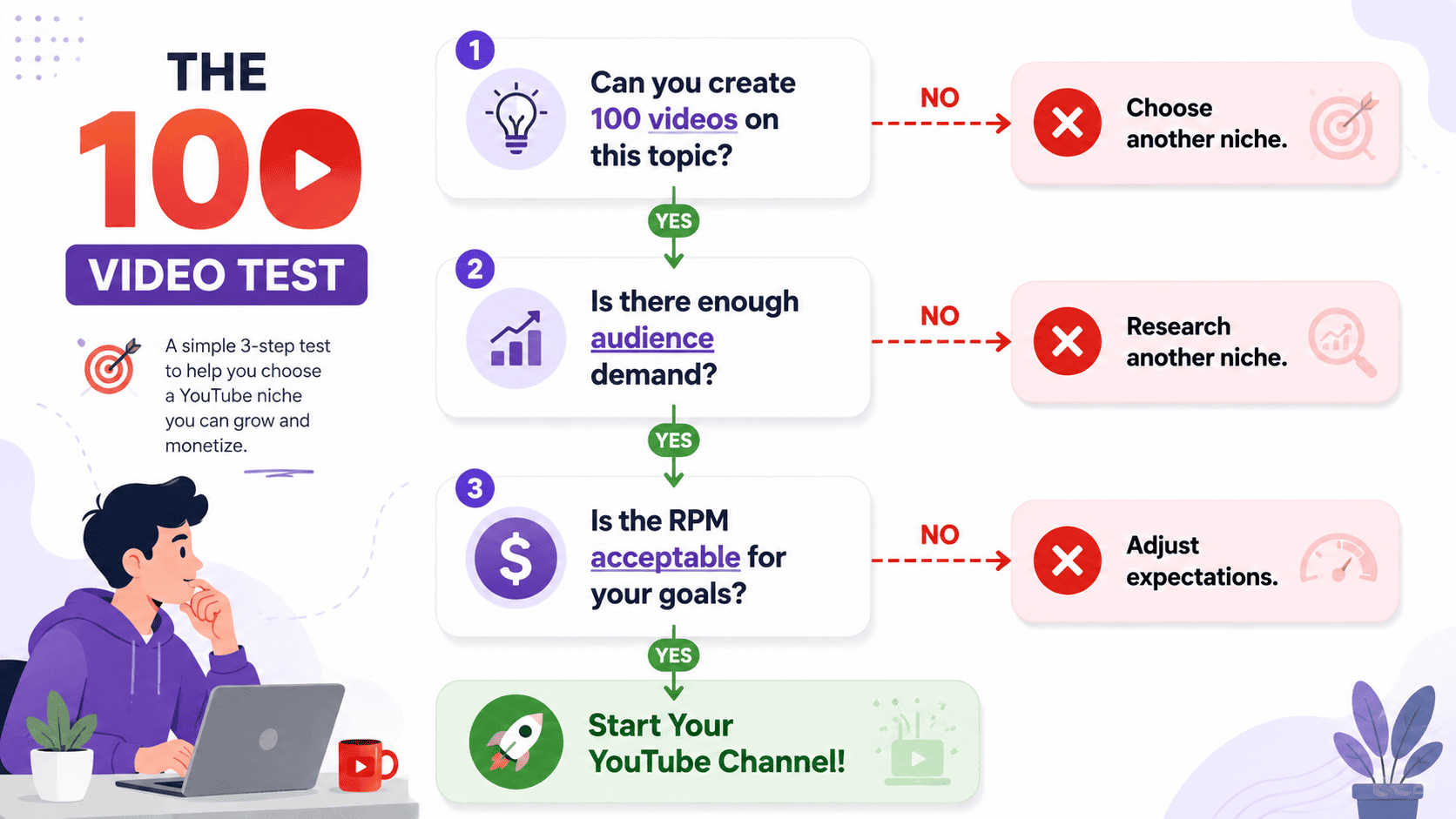
Can I imagine making 100 videos about this without burning out?
Not "can I make 5 right now." Not "is this interesting today." Hundred-video question. Because at roughly one video a week, that's about two years of consistent content. If you can't picture yourself still wanting to make videos about this topic in 24 months, the niche is wrong for you.
The way to actually test this: try writing out 30 specific video ideas in your potential niche, right now. Not "general tutorials" but specific concrete ideas. "How to set up a budget meal-prep system for $40 a week." "Why nobody talks about [specific thing] in [niche]." "I tried [specific approach] for 30 days, here's what happened."
If you struggle past 12 ideas, the niche is too narrow or you don't know it well enough yet. Pick something else.
If you breeze past 30 and could keep going, you have enough depth. Move forward.
The Three Honest Filters
Once you have a niche that passes the "100 videos" test, run it through three filters.
Knowledge or willingness to deeply learn. Faking expertise on YouTube is increasingly hard. Audiences are sharp and audiences in monetizable niches are sharper. You either need real experience in the topic, or you need to be genuinely willing to spend the next two years becoming an expert in it. Halfway between the two is the worst place to be.
I'd specifically avoid niches where the surface looks easy but the depth requires actual credentials. Finance for example. The surface looks like "talk about money." The depth requires actually understanding personal finance, taxes, and investing well enough that you don't say things that would get you sued. If you're not willing to put in that depth, the niche will eat you.
Verifiable audience demand. You can test this in 10 minutes. Type your potential niche topic into YouTube and see what auto-completes. If you get rich autocomplete (multiple specific searches), the demand is real. If autocomplete is sparse or unrelated, demand is weak.
Look at successful channels in the niche. How many subscribers do they have? What are their typical view counts? If you find 5+ established channels with healthy view counts, the niche has room. If you find one giant channel and a graveyard of dead small ones, you might not have viable space.
**Monetization potential you can stomach.**Monetization potential matters too.
Some niches consistently attract higher advertiser demand than others. For example, finance-related channels often report much higher RPMs than gaming or entertainment channels.
While researching RPM ranges for the YTKits Revenue Estimator, I found that audience country, niche, advertiser demand, and video format all have a significant impact on earnings.
If you want a detailed breakdown, I've covered typical RPM ranges by category in my YouTube Categories by RPM guide.
A few highlights from that data:
| Category | Country | Videos ≥ 8 Min | RPM Tier |
|---|---|---|---|
| Finance | India | $0.56 – $3.50 | Premium |
| Online Income | India | $0.45 – $3.08 | Premium |
| Science & Technology | India | $0.42 – $2.80 | High |
| Entertainment | India | $0.39 – $1.40 | Medium |
| Gaming | India | $0.22 – $0.65 | Moderate |
| ASMR | India | $0.17 – $0.64 | Low |
Going Specific Instead of Broad
The biggest single shift in niche thinking I'd recommend: go more specific than feels natural.
"Tech" is way too broad. "Tech for seniors" is workable. "Budget tech reviews for first-time buyers" is even better. "Productivity software comparisons for freelancers" is excellent.
Why narrower wins:
Less competition. Hundreds of "tech" channels exist. Maybe a few dozen "tech for seniors" channels exist. You can break through faster. Specific positioning reduces competition significantly.
Better engagement. Specific audiences are more devoted than general audiences. People who watch productivity-software-for-freelancers content are deeply interested. They'll comment, share, subscribe, and stick around.
Easier ranking. Narrow keywords are less competitive. Long-tail keywords are easier to rank for and attract higher-intent viewers. A new channel can rank for "best CRM for freelance designers" but cannot rank for "best CRM."
Better sponsorship economics. Brands targeting a specific audience pay way more per viewer than brands buying broad reach. A 20K-subscriber channel with a specific audience can outearn a 200K-subscriber generalist for sponsorships.
The trade-off is ceiling. A niche-of-a-niche channel might top out at 100K subscribers where a generalist could hit a million. But for most creators, "make great money with a smaller audience" beats "potentially get huge but probably don't."
The Niche Trap to Avoid
The trap I fell into: picking a niche purely because it paid well, without checking whether I'd actually sustain making content about it.
If you pick finance because it pays $20 RPM but you don't actually find money topics interesting, you'll burn out. From what I've seen, burnout ends far more creator journeys than competition does.
Equally, if you pick gaming because you love it but you'll resent the $2 RPM after monetization, you'll burn out from the opposite direction. The frustration of making serious income work in a low-paying niche is real.
The honest version of the question is: among niches you can sustainably make content about, pick the one that pays best. Among niches that pay decently, pick the one you can sustainably make content about.
Don't optimize for one variable. Optimize for the intersection.
The Biggest Mistake I Almost Made
When I first started learning about YouTube, I nearly chose a niche simply because everyone said it had a high RPM.
On paper, it looked like the smart decision.
But every time I tried planning videos, I felt completely disconnected from the topic.
Looking back, I don't think I would have lasted six months.
The niche wasn't bad.
It just wasn't the right niche for me.
That experience completely changed how I think about YouTube.
Today, I always look for the intersection of sustainability, audience demand and monetization—not just the highest RPM.
How to Test Before Committing
You don't have to commit hard before you know. Test first.
Make 5 videos in your potential niche. Just 5. See how you feel about the process. Did you enjoy making them? Did you find topics easily or did each one feel like pulling teeth? Did even unsubscribed viewers find them through search?
After 5 videos, you'll have answers to questions you couldn't have predicted from a Venn diagram. The niche either feels sustainable or it doesn't. Search traffic either materializes or it doesn't. Your video ideas list either grows or shrinks.
If the test goes well, commit. If it doesn't, you've only "lost" 5 videos and you have real data to pick a better niche.
I wish I'd done this with my first channel. I'd have figured out my niche was wrong in two months instead of nine.
Pivoting Without Killing Your Channel
If you're already in a niche and considering switching, here's what to know.
Hard pivots usually crater the channel. If you build a gaming channel for two years and abruptly switch to finance, almost none of your gaming audience will follow you. You're effectively starting over.
Soft pivots work better. Gaming → gaming tech → tech generally → tech for entrepreneurs. Each step is logical from the previous. Existing subscribers stay engaged with the bridge content. New subscribers find you in the new direction. By the time you're fully in the new niche, you brought a decent percentage of the old audience with you.
Starting a second channel is also an option. Keep the original niche where it is. Test the new niche on a new channel. See which grows faster. Double down on the winner. The downside is you're managing two channels with limited time. Most creators can't sustain it.
The third option is finding the higher-RPM angle within your current niche. Travel vlogs pay poorly. Travel hacking with credit cards pays well. Same niche family. Just a more commercial angle. You can stay close to what you do and pull in better economics without a full pivot.
What I'd Actually Do If I Was Starting Over
Concrete process:
I'd brainstorm 10-15 topics I could imagine making 100 videos about. Not "what pays well" — what I could sustain.
I'd narrow to 5 based on which ones I could imagine still enjoying in two years.
I'd check audience demand on each one by typing them into YouTube and seeing autocomplete plus finding existing successful channels.
I'd check RPM expectations using the Revenue Estimator on established channels in each niche.
I'd cross out any niches where the demand is thin or the RPM is too low to stomach.
I'd run a 5-video test in my top pick before committing fully.
That whole process takes maybe a week. Saves you months of building in the wrong direction.
Behind This Article
Everything in this guide comes from three places.
First, my own experience choosing the wrong niche on my first YouTube channel and later finding a direction I could genuinely sustain.
Second, more than five years of creating YouTube content, experimenting with different strategies, and seeing firsthand how difficult long-term consistency becomes when you don't enjoy your niche.
Third, building YTKits, where I've researched thousands of creator channels while developing tools for revenue estimation, keyword research, monetization, and channel analysis.
Whenever I discuss my own experiences, they're based on my personal YouTube journey.
Whenever I discuss RPM ranges or audience demand, they're based on publicly available creator reports, YouTube documentation, and the research behind YTKits.
Frequently Asked Questions
Can I have more than one YouTube niche?
Yes. Many creators eventually expand into related topics. The important thing is making the transition gradually so your audience understands why the content is changing.
Should I start broad or narrow?
I recommend starting narrower than you think. It's usually easier to expand later than to compete immediately with huge general channels.
Can I change my niche later?
Absolutely. I've seen many creators pivot successfully. Just try to move gradually into related topics rather than changing everything overnight.
Should I choose a niche with the highest RPM?
Not necessarily. A niche with lower RPM that you genuinely enjoy is often more sustainable than a high-paying niche you hate.
Does YouTube punish niche changes?
No. YouTube doesn't punish niche changes. However, your existing audience may not be interested in the new content, which can reduce early performance.
How do I know if I've chosen the right niche?
That's exactly why I use the 100 Video Test. If you can comfortably think of 100 useful videos, you're probably choosing a niche you can sustain.
The Bottom Line
If there's one lesson I'd give my younger self, it's this:
Don't choose a niche because someone on YouTube says it's profitable.
Choose a niche that passes your own 100 Video Test.
You can always improve titles.
You can always improve thumbnails.
You can always improve editing.
But it's almost impossible to fake genuine interest in a topic for hundreds of videos.
That's why I believe your niche isn't just the subject you upload.
It's the commitment you're willing to keep making when nobody is watching.
Related Tools
- Revenue Estimator - Check earnings potential in your potential niches
- Keywords Extractor - Validate search demand in your niche
- Monetization Checker - Track progress in your chosen direction