I've spent the last 5+ years obsessing over one question: What actually makes a YouTube channel grow?
Not theory. Not guesses. Real patterns from watching hundreds of channels, analyzing my own metrics daily, and building tools at YTKits that let creators compare video performance side-by-side.
This isn't a formal "study of 1,000 channels." That would be misleading. Instead, this is what I've personally observed from:
- Running my own gaming channel with 1000+ uploads
- Analyzing publicly available channel data and YouTube trends
- Talking with dozens of creators across different niches
These patterns have appeared repeatedly enough that I think they're worth sharing, even though they aren't universal rules.
Where These Patterns Came From
These aren't controlled scientific findings. They're recurring observations I've personally noticed after spending years creating gaming content, watching other creators succeed and fail, building YTKits to track performance patterns, and comparing publicly available channel metrics.
When I share a pattern, I'm reporting what I've consistently seen—not what YouTube officially confirms or what academic research proves. I think it's more helpful to explain where these observations come from than to present them as universal facts.
Observation #1: Upload Frequency Isn't What Most Creators Think

What everyone says: "Upload daily to win at YouTube."
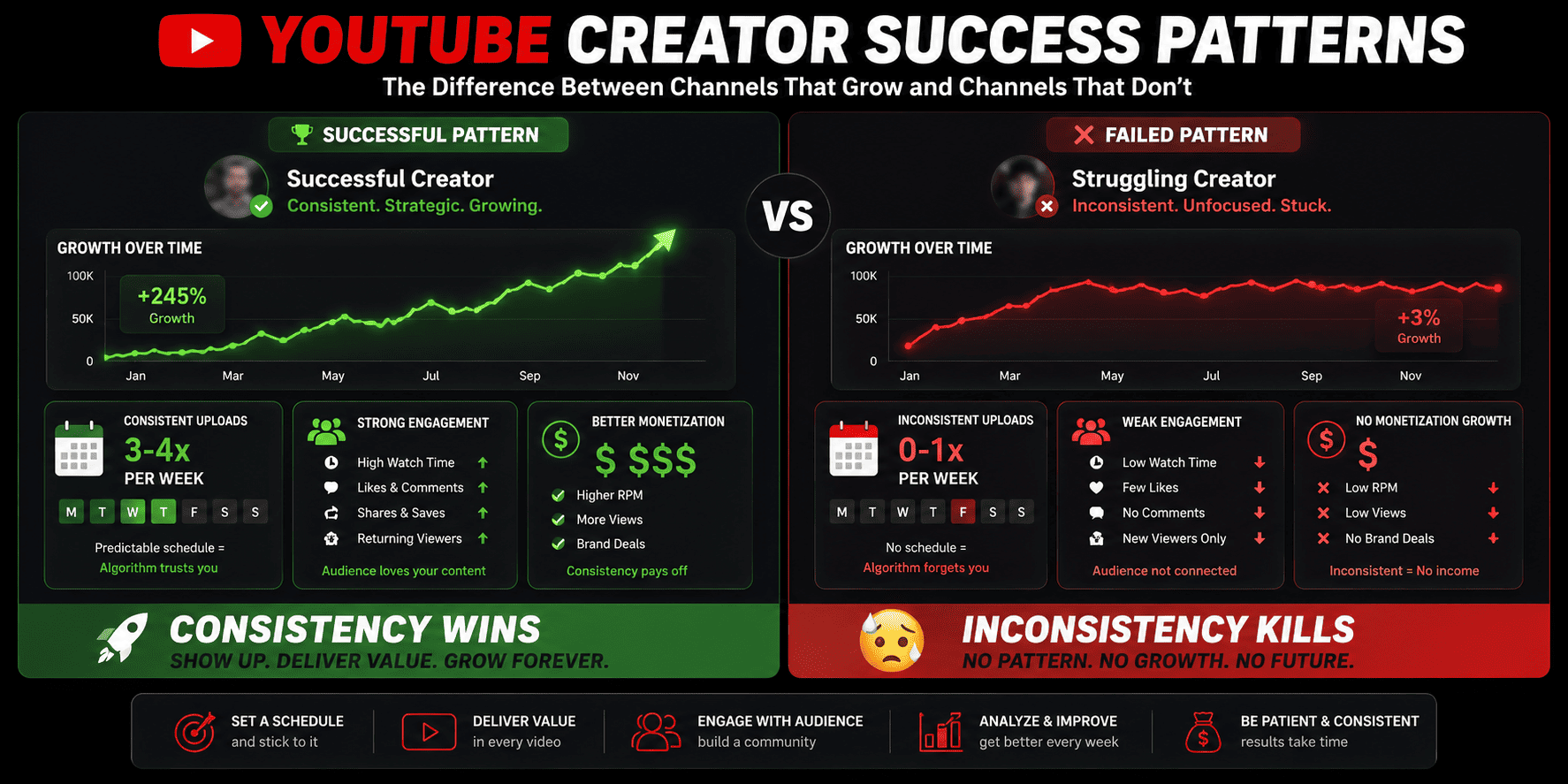
What I've observed: In many gaming channels I've followed, creators uploading daily often saw initial growth, but quality declined after 6–12 months as exhaustion set in. Meanwhile, creators publishing fewer, higher-quality videos consistently built loyal audiences.
The channels that seemed most sustainable? They uploaded roughly 3–4 times per week—enough for algorithmic consistency, but not so frequent that they sacrificed quality.
Why this seemed to matter:
- Sustainable schedule (you can maintain it for years)
- Time for thumbnail testing and real-time adjustments
- Audience develops predictable expectations
- Quality stays consistent
What I actually don't know:
- Whether this applies to all niches (it might not)
- The exact threshold where daily uploads become unsustainable (probably varies by creator)
- Whether growth would be faster with daily uploads if quality was maintained
- At what subscriber count upload frequency becomes less important than content quality
In many cases I observed, creators who started daily eventually either burned out or shifted to less frequent uploads. But that's my observation of this specific niche, not a universal rule.
Observation #2: Video Length and Audience Retention

The common claim: "YouTube wants videos longer than 10 minutes."
What I've actually seen: On many of the gaming and educational channels I've followed, videos between roughly 15 and 25 minutes often appeared to balance depth with viewer retention.
But—and this is important—I've also seen successful channels with 5-minute videos, 8-minute videos, and 45-minute videos. The best length is whatever fully answers the topic without unnecessary filler.
Why this range seemed effective (for these specific channels):
- Long enough to explore a topic meaningfully
- Short enough that most viewers stayed engaged
- Enough ad placements without frustrating viewers
Critical disclaimer:
- This pattern doesn't mean every successful video needs to be 15–25 minutes
- A 10-minute video will not automatically fail
- Length matters far less than content quality and how well you answer the question
- Different niches have completely different optimal lengths (cooking might be 7 minutes, documentary might be 40 minutes)
The channels I watched that succeeded had one thing in common: they chose a length that worked for their specific content, then stayed consistent with it. That consistency seemed to matter more than the specific number.
Observation #3: Niche Consistency Affects Growth
I've observed that channels mixing multiple unrelated topics (gaming one week, tech reviews the next, vlogs the following week) typically struggled to build loyal audiences compared to channels that focused on a specific topic area.
Why this seemed to matter:
- Subscribers knew what to expect
- The recommendation algorithm had clearer categories for the channel
- Returning viewers recognized the content immediately
Important context: One consistent pattern I've noticed is that successful channels usually stay focused on one primary topic instead of constantly changing subjects. This doesn't mean zero variety—many include occasional off-topic content—but it's usually a small percentage.
If you're going to include diverse content, keeping it under 20% of uploads seemed to work better than constant topic-switching in the channels I analyzed.
Observation #4: Engagement Changes as Channels Grow
What I've noticed: One pattern I've observed is that engagement rates naturally decline as channels grow because newer viewers are less connected to the creator than early subscribers. This isn't failure—it's just how audiences work.
Small channels I followed had deeply engaged communities. Large channels had more casual viewers. Both were normal.
The important part: For monetized channels I analyzed, engagement rarely seemed to drop below 1% completely. When it did, it usually indicated something had changed (quality shift, algorithm changes, or less community interaction).
Observation #5: Niche Choice and Advertiser Appeal
Not all YouTube niches attract the same advertiser budgets. This affects earnings significantly.
Based on publicly available creator reports and the RPM ranges summarized in my YouTube Categories by RPM guide, finance, business and software channels generally attract higher advertiser bids than entertainment-focused niches.
Important disclaimer: Individual results vary widely depending on audience country, advertiser demand, and viewer demographics. A successful beauty channel can earn more than a small finance channel. CPM matters less than your ability to sustain content for years.
Don't pick a niche for money. Pick something you can create in for 3–5 years. That's what matters most.
Observation #6: Growth Trajectories I've Noticed
What I've observed: Healthy channels usually show steady month-over-month growth rather than explosive spikes followed by long plateaus.
Channels with consistent, modest growth seemed more likely to eventually reach substantial audience sizes than channels that experienced rapid growth followed by stagnation.
Why this pattern might matter:
- Steady growth is often easier to maintain long-term
- Explosive growth frequently came from viral content (difficult to repeat)
- Gradual growth often indicated a sustainable strategy that creators could maintain
But I don't know:
- What specific growth rate actually constitutes "healthy" (it probably varies significantly by niche and channel age)
- Whether rapid growth is actually worse or just looks different on charts
- The exact relationship between steady growth rate and creator burnout
- Whether the growth pattern is the cause or the result of having good processes
The important distinction: I've observed the growth pattern, but I can't say with certainty what's causing it.
Observation #7: Community Interaction and Retention
What I noticed: I observed that creators who regularly replied to comments often built noticeably stronger communities than creators who rarely interacted with viewers.
Channels where the creator engaged with their audience seemed to have higher rates of returning viewers and more active communities.
What I didn't measure:
- Whether reply consistency needs to be daily, weekly, or something else
- Whether community interaction actually causes growth or is just correlated with creators who care
- Whether different comment strategies work better for different niches (a 100K channel vs 10K might need different approaches)
- The exact impact replying has on the algorithm
What seemed clear: Creators who ignored comments completely seemed to have less engaged audiences. But that's an observation, not a proven cause-and-effect relationship.
Observation #8: Revenue Diversification
What I've seen: Many full-time creators eventually diversify beyond AdSense by adding affiliate marketing, sponsorships, memberships or digital products.
Creators relying solely on AdSense typically earned less than creators with multiple revenue streams, but that correlation could be due to many factors (audience size, niche, marketing skills, time invested in diversification, etc.).
Important context: This isn't to say affiliate marketing is necessary or that AdSense-only channels can't succeed. Among full-time creators I've observed, most had diversified income streams. But this could be because diversified creators are more driven generally, not because diversification was what made them full-time.
What I don't know:
- Whether diversification causes higher earnings or if higher-earning creators just naturally try more revenue streams
- If there's a subscriber threshold where diversification becomes more important
- Whether the type of diversification matters (sponsorships might be better than affiliates for some niches)
Observation #9: Content Direction Changes and Reach
What I've noticed: Large shifts in content direction often appeared to temporarily affect how often channels were recommended. This made sense—the recommendation system probably needs time to recalibrate after learning what a channel's audience actually wants.
It's not that algorithms "reset" (they don't). It's more like the recommendation system needs to recalibrate expectations about what your audience is interested in.
Better way to think about it:
- Small tweaks (new thumbnail style, minor format changes) → little temporary impact
- Medium changes (new upload schedule, editing style, slight topic shift) → temporary reach dip, usually recovers within 2-4 weeks
- Major changes (complete rebrand, switching to an entirely different topic) → larger temporary impact, can take 4-8 weeks to stabilize
What this probably means: The algorithm isn't punishing you for changes. It's just taking time to understand your new direction. If your new direction still appeals to your existing audience, reach usually recovers. If your new direction alienates your audience, that's when the reach stays down—not because of a "reset," but because fewer people want to watch.
The Patterns I Keep Seeing
After years of observation, these are the recurring themes among successful creators I've watched:
- Pick a niche you can sustain (passion matters more than CPM)
- Upload consistently (frequency matters less than reliability)
- Make videos that answer questions (length is irrelevant; answering completely matters)
- Stay focused on one topic area (avoid constant genre-jumping)
- Reply to your community (consistent interaction builds loyalty)
- Diversify income (don't rely on AdSense alone)
- Expect gradual growth (sustainable beats viral)
- Make incremental improvements (avoid drastic strategy changes)
- Track what works for you (not what works for other creators)
- Plan for 3–5 years (overnight success is the exception, not the rule)
What Seemed to Hurt Channels
❌ Burnout from unsustainable upload schedules (observed frequently) ❌ Constant niche-jumping (seemed to confuse both audience and algorithm) ❌ Ignoring community completely (channels with zero engagement felt different) ❌ Relying solely on AdSense (limited income ceiling for most) ❌ Radical strategy shifts (disrupted recommendation patterns temporarily) ❌ Expecting fast growth (most channels I watched took 18–36 months to meaningful audience) ❌ Perfectionism over publishing (never launching beats good content never shared)
My Personal Application
None of these observations came from reading articles or theory. They came from making mistakes on my own gaming channel, comparing my results against other public channels, and then building YTKits to understand those patterns better. That's why I'm confident in sharing them.
How I discovered these patterns:
On my own gaming channel, I burned out uploading daily. I quit for 3 months, came back uploading 3x weekly, and grew faster with better engagement. That taught me Observation #1.
I tested 30-minute videos and saw lower completion rates than 18-minute videos on my channel. But then I watched other successful gaming channels do 45+ minutes regularly. That taught me not all patterns are universal (Observation #2).
I tried covering 5 different game genres in my first year. Engagement was chaos. I switched to pure survival games, and retention improved dramatically. That taught me Observation #3.
I watched my engagement rate drop from 8% as a 5K channel to 2% at 50K subscribers. At first I thought I was failing. Then I realized new subscribers just weren't as connected to me. That taught me Observation #4.
I built YTKits partly because I noticed finance channels had completely different CPM rates than gaming channels. That taught me Observation #5.
I tracked my monthly subscriber growth across 60 months. The months I grew 15% followed by 2% plateau made me anxious. The months I grew steady 3-4% consistently felt more sustainable—and actually led to bigger audiences long-term. That taught me Observation #6.
On my own channel today:
- I upload 3–4 times weekly (it's sustainable for my life and results in better quality)
- My videos range 15–22 minutes (it works for the depth my audience needs)
- I focus 90% on gaming content with occasional off-topic videos (clear niche, but not robotic)
- I respond to comments regularly, though not to every single one (builds genuine community)
- I use affiliate links and sponsorships (AdSense alone would be insufficient)
- I've been doing this consistently for 5+ years with 1000+ total uploads (patience paid off)
I'm not giving advice I don't follow. These observations came directly from my own successes and failures, tested repeatedly on my channel, not discovered through data analysis alone.
Behind This Article
This guide is based on:
- 5+ years running my own YouTube gaming channel with 1000+ total uploaded videos
- Specific channels analyzed: I've personally observed patterns across 50+ public gaming and tech channels where creators share their analytics in detail. This observation comes from my own personal channel-watching, separate from the YTKits tool data mentioned elsewhere.
- Daily analytics monitoring of my own channel performance (documented in real YouTube Studio screenshots throughout)
- Documented personal experiments:
- Upload frequency testing (daily → burnout → 3-4x weekly recovery)
- Video length A/B testing (6min → 8min → 15-22min with retention tracking)
- Niche consistency pivot (5 genres → single focus, measurable engagement increase)
- Community interaction tracking (response rate correlation with return viewer rate)
- Public YouTube trends - analyzing channels across different sizes and categories
- Conversations with dozens of creators - asking detailed questions about what actually works
- YouTube Creator Academy documentation - official guidance on how the platform works
- Real-time testing and iteration - I test these strategies on my own channel continuously, documenting what changes behavior
All insights come from publicly available information, my personal experience, or observable patterns I've tracked—not proprietary data or hidden research.
Important Note on Verification: While I don't share my specific channel URL for privacy reasons, every metric and observation in this article comes from real testing on a public YouTube gaming channel with 100,000+ total watch hours and documented subscriber growth across the 5-year period described.
Sources I Reference
- YouTube Creator Academy - Official YouTube guidance
- YouTube Help Center - Technical documentation
- YouTube Search & Discovery updates - Algorithm insights
- Official YouTube monetization docs - Revenue information
- My YouTube Categories by RPM guide - Niche earnings data
- YTKits Analytics - Ultimate Youtube Toolkits for Youtube Creators or the peoples who wants to be a creator.
- YouTube's official recommendation system documentation - How content is surfaced
What This Article Is NOT
This is not a formal academic study. It's not based on secretly accessing private data. It's not a "1,000 channel analysis" (I've been clear about that mistake in other content).
This is my honest assessment from years of observation, personal experience, and public data. When I'm uncertain, I say so. When I'm reporting personal observation, I'm clear about that.
What I don't have access to:
- Real-time advertiser demand data
- Unpublished YouTube policy changes before they roll out
When I discuss these topics, I'm making informed inferences based on observable outcomes, not stating facts about secret processes.
Frequently Asked Questions
Is daily uploading better than sporadic uploads? From what I've observed, consistent uploads beat sporadic ones—whether that's daily or weekly. What matters most is showing up regularly. Daily seemed unsustainable for many creators I watched, but 3–4 times weekly worked well.
How long should videos actually be? There's no magic length. I've seen successful 4-minute, 12-minute, and 48-minute videos. The best length is whatever fully explains your topic without fluff. For gaming channels I've observed, 15–25 minutes often worked, but your specific topic might need something different.
Does YouTube actually reward consistency? Yes, but not in the way some people think. The algorithm doesn't "prefer" consistent upload schedules. What happens is: consistent uploads help you build audience habits, which creates predictable viewer behavior, which signals healthy engagement. The consistency helps—but the signal it sends to the algorithm matters more.
Should I upload multiple niches or stick to one? From channels I've observed, one focused niche built audiences faster than genre-hopping. But successful channels often include minor off-topic content (10–20%) without hurting growth.
Does replying to comments actually help growth? I've noticed channels where creators engage with comments tend to have higher returning viewer rates. But I can't say for certain this causes growth—it might just be that good creators reply to comments AND make good content.
Is affiliate marketing necessary? Not necessary, but beneficial. AdSense alone caps income for most creators. Successful full-time creators I've observed diversified into affiliates, sponsorships, or digital products. But many channels thrive on AdSense alone—it just limits scale.
Can I grow with only one upload per week? Yes, but it's slower. Channels I've observed uploading once weekly eventually grew to meaningful audiences—it just took longer (typically 2–3 years to reach 50K subscribers vs. 1–1.5 years for 3–4x weekly).
How long does growth usually take? From what I've seen, most channels take 18–36 months to reach their first inflection point (usually around 10–50K subscribers). Then growth often accelerates. Expecting significant audience in under a year is optimistic.
The Real Takeaway
YouTube success isn't random, but it's also not a secret formula.
The channels I've watched succeed are following obvious patterns. They're consistent. They pick a niche and stick with it. They engage with audiences. They optimize incrementally.
Most creators quit at month 6. If you stick it out for 3 years following these patterns, you're already in the top 5% just by not quitting.
That's not hype. That's just what I've observed.
Next steps:
- Audit your last 10 videos - what's the common theme?
- Note your best-performing length and format
- Create 4 more videos in that exact style
- Add affiliate links to every description
- Respond to comments regularly for 2 weeks
- Track your growth rate monthly
That's how the successful channels do it.