You've probably searched for a YouTube channel's estimated earnings and noticed that every website gives you a different answer.
That isn't because one calculator is always right and another is always wrong—it's because each tool makes different assumptions behind the scenes.
I discovered this firsthand while building the YTKits Revenue Estimator.
When I started developing the tool, I expected to find a reasonably standard way of estimating YouTube earnings.
Instead, I found that different calculators could produce dramatically different estimates for the exact same channel because they each relied on different assumptions about RPM, niche, audience location, and monetization.
That experience led me to dig much deeper into how public revenue calculators actually work, what they can realistically estimate, and where their limitations begin.
In this guide, I'll explain the methodology behind YouTube revenue calculators, why estimates vary so much, and what I learned while building one myself.
Key Takeaways
- YouTube revenue calculators estimate earnings using publicly available data rather than private YouTube Analytics.
- Estimated earnings differ because every calculator uses different RPM, CPM, niche, and country assumptions.
- No public website can see sponsorship income, memberships, Super Chats, YouTube Premium revenue, or creator dashboards.
- Audience location, niche, seasonality, and video format have a major impact on estimated YouTube income.
- Revenue ranges are significantly more reliable than displaying one exact earnings number.
- Understanding estimation methods helps creators set realistic expectations before monetizing a channel.
- Transparent methodologies build more trust than unrealistic "exact income" claims.
Before explaining how these tools work, it's worth understanding one important point: no public website—including mine—can see a creator's real YouTube earnings. Everything starts with estimation.
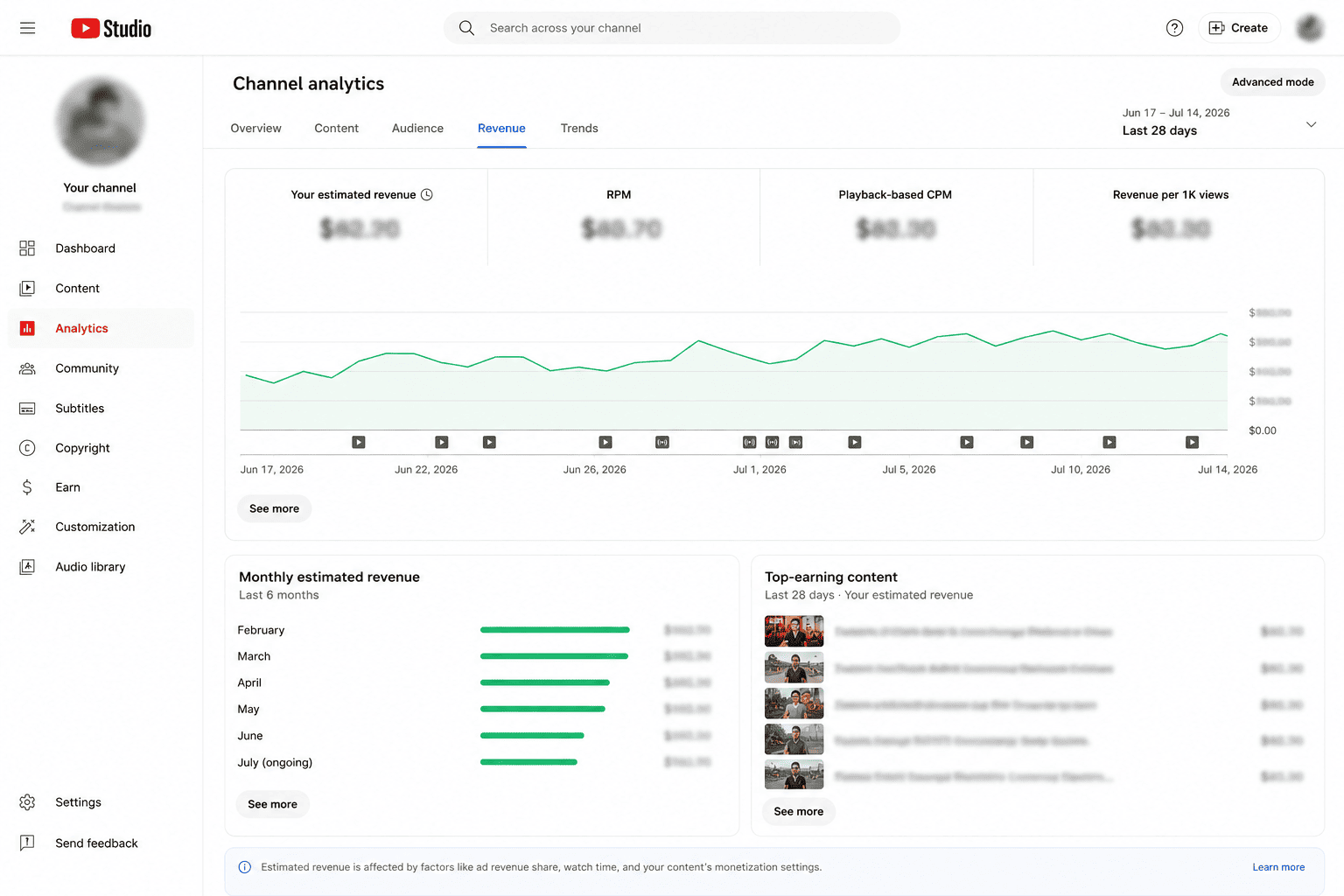 Illustrative mockup of a YouTube Studio Revenue dashboard. Private earnings are intentionally blurred because they aren't publicly accessible.
What Is a YouTube Revenue Calculator?
A YouTube revenue calculator is a tool that estimates a channel's advertising earnings using publicly available data and assumed RPM or CPM values rather than private YouTube Analytics.
Unlike YouTube Studio, public calculators cannot access a creator's real earnings dashboard. Instead, they analyze information that anyone can see—such as total views, video count, upload frequency, and sometimes the channel's category—before applying estimated advertising rates.
For example, if a channel has accumulated 50 million public views, a calculator might estimate revenue by multiplying those views by an assumed RPM range.
Important: a calculator estimates advertising income—not total creator income.
Revenue sources that remain completely private include:
- Sponsorships
- Brand deals
- Affiliate marketing
- Merchandise sales
- Course sales
- Memberships
- Super Chats
- Super Thanks
- Gifts
- External business income
Statistic: YouTube's Analytics APIs require authorization from the channel owner to access analytics and monetary reports, meaning public websites cannot retrieve another creator's private earnings.
While testing different estimation models during development, I realized people weren't only using revenue calculators out of curiosity. Creators, agencies, marketers, and researchers were all using them for different reasons—which is why understanding their limitations matters just as much as understanding how they work.
Why Do YouTube Revenue Calculators Matter?
Revenue calculators help creators, businesses, marketers, and researchers estimate the earning potential of YouTube channels when actual revenue isn't available to them.
For creators
Creators use calculators to estimate:
- Future earnings
- Monetization potential
- Growth goals
- Niche profitability
For example, a new finance creator may compare estimated RPMs with gaming channels before deciding which content strategy to pursue.
For businesses
Brands often estimate whether a creator is likely generating sustainable income before approaching them for sponsorships.
For advertisers
Advertisers use estimates to understand market value across different industries.
For viewers
Many people are simply curious:
- How much does MrBeast make?
- How much does a gaming creator earn?
- Can YouTube really become a full-time career?
Revenue calculators provide educational estimates—not verified financial statements.
How Do YouTube Revenue Calculators Estimate Earnings?
When I began building the first version of the YTKits Revenue Estimator, I thought the calculation would be straightforward.
Collect a channel's views. Apply an RPM. Show an estimated revenue.
It turned out to be much more complicated. Very quickly I realized there wasn't a single "correct" RPM, because earnings vary depending on niche, audience location, seasonality, monetization methods, and dozens of other factors. That realization completely changed how I approached the project.
Here's the process that most public revenue calculators—including mine—follow at a high level.
Step 1: Collect Public YouTube Data
First, the calculator retrieves information available through YouTube's public API or publicly visible pages.
Typical data includes:
- Channel name
- Total views
- Subscriber count
- Video count
- Upload frequency
- Public category (when available)
Notice what's missing:
- Actual earnings
- RPM
- CPM
- Audience demographics
- Watch time revenue
- Membership income
Statistic: the YouTube Analytics API provides revenue metrics only for authorized owners or eligible content owners—not for public lookups of other channels. — Source: Google for Developers, 2026 (Google for Developers)
Step 2: Determine the Channel's Category
Many modern calculators try to determine the channel's niche.
For example:
| Channel Type | Typical Estimation Strategy |
|---|---|
| Finance | Higher RPM assumption |
| Technology | Medium-high RPM |
| Gaming | Medium RPM |
| Entertainment | Medium RPM |
| Music | Lower advertising RPM |
| Shorts-focused | Separate Shorts assumptions |
Different tools handle this step differently. Some rely on the creator's YouTube category. Some use their own category classification systems. Others ask the user to choose the channel's niche manually.
For the YTKits Revenue Estimator, I let users select the category themselves because public data alone isn't always enough to classify a channel accurately. If users aren't sure, they can use the separate YTKits Category Predictor to help identify the most suitable category before estimating revenue.
YTKits YouTube Category Predictor
Here is my category tool result for the PewDiePie channel:

Step 3: Estimate Audience Country
Country matters because advertisers pay different amounts across regions.
For example:
- United States generally has higher advertiser demand.
- United Kingdom often earns higher CPM than many developing markets.
- India may generate lower average advertising rates despite large view counts.
Since public calculators cannot see audience geography, they make assumptions based on user input or defaults.
Step 4: Apply Estimated RPM
RPM stands for Revenue Per Mille, or revenue earned per 1,000 views after YouTube's revenue share and including eligible revenue sources reported in Analytics. (Google Help)
Simplified estimation formula:
Estimated Revenue = (Total Views ÷ 1,000) × Estimated RPM
Example:
- Total Views = 8,000,000
- Estimated RPM = $2.80
Estimated Revenue: 8,000 × $2.80 = $22,400
This remains an estimate—not an exact payout. YTKits YouTube Revenue Checker
Original Flow Diagram
Public Channel URL
        │
        ▼
Collect Public Data
        │
        ▼
Select Channel Category
(Optional or User Selected)
        │
        ▼
Choose Audience Country
        │
        ▼
Apply Category-Based RPM Range
        │
        ▼
Estimated Revenue Range
Revenue Tool Searchbar
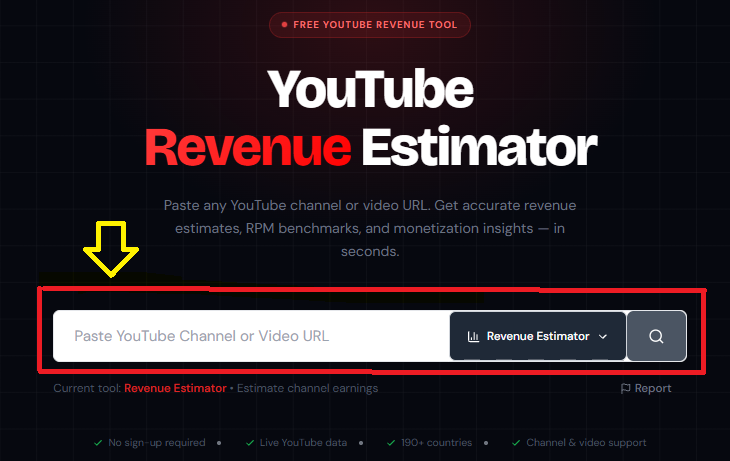
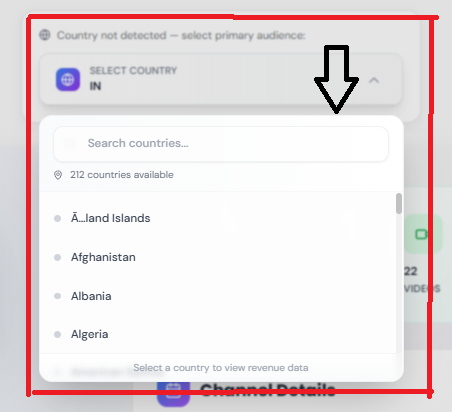 Country Selection
 Category Selection
Why Do Different YouTube Revenue Calculators Show Different Results?
This is the biggest reason users become confused: every tool leans on a different mix of assumptions, datasets, and update schedules.
RPM assumptions differ
One calculator might assume $1.50 RPM. Another assumes $4.00 RPM. That difference alone can double estimated earnings.
Category mapping differs
One calculator labels a creator as Entertainment. Another classifies them as Education. Each category typically uses different advertiser demand assumptions.
Country assumptions differ
Without audience analytics, calculators cannot know viewer locations, language distribution, or purchasing power. Instead, they estimate.
Update frequency differs
Some databases refresh daily. Others refresh weekly or monthly. Older data naturally produces different estimates.
Can Any Website Calculate a YouTuber's Exact Income?
No—because YouTube does not expose earnings data through its public API. Only creators themselves can view complete revenue inside YouTube Studio.
Private earnings include:
- Ad revenue
- Memberships
- Premium revenue
- Super Chats
- Super Thanks
- Shopping revenue
- Sponsorship payments
- Affiliate commissions
Even if two channels receive exactly one million views, their earnings can differ dramatically.
Why Do RPM and CPM Matter for Revenue Estimation?
They represent two different sides of YouTube monetization, and mixing them up is one of the most common sources of confusion. YouTube RPM vs CPM explained
| Metric | Meaning | Used By |
|---|---|---|
| CPM | Cost advertisers pay per 1,000 ad impressions before revenue share | Advertisers |
| RPM | Revenue creators receive per 1,000 views after revenue share | Creators |
Google explains that RPM includes multiple eligible revenue sources shown in YouTube Analytics, while CPM reflects advertiser spending before YouTube's revenue share. (Google Help)
Does Audience Country Affect YouTube Revenue Estimates?
Yes, significantly—advertising demand differs across regions.
For example, a finance channel targeting U.S. viewers may earn substantially more per thousand views than a similar channel targeting countries with lower advertising rates. Seasonal advertising also changes revenue: fourth-quarter holiday campaigns often increase advertiser competition, while January can see lower advertising demand.
Two YouTube channels with identical view counts can end up with very different earnings once you factor in advertiser demand, audience geography, video format, and monetization methods.
What Building a Revenue Estimator Taught Me
While building the YTKits Revenue Estimator, I quickly realized there was no single "correct" RPM for every channel. Instead of displaying a misleading fixed number, I focused on producing realistic ranges.
I also realized there wasn't enough public information to reliably identify every channel's niche. Rather than pretending to know the correct category, I decided to let users choose it themselves. If someone isn't sure which category best fits a channel, they can use the separate YTKits Category Predictor before running the revenue estimate.
My development process included:
- Researching publicly discussed RPM benchmarks across niches.
- Using category-based RPM ranges instead of one universal value.
- Allowing country selection to reflect regional advertising differences.
- Allowing category selection if you think the channel's detected category isn't correct.
- Showing minimum and maximum estimated earnings rather than one exact figure.
This approach reflects how creators actually experience YouTube revenue: it varies from month to month based on advertiser demand, viewer location, and content type.
Internal links:
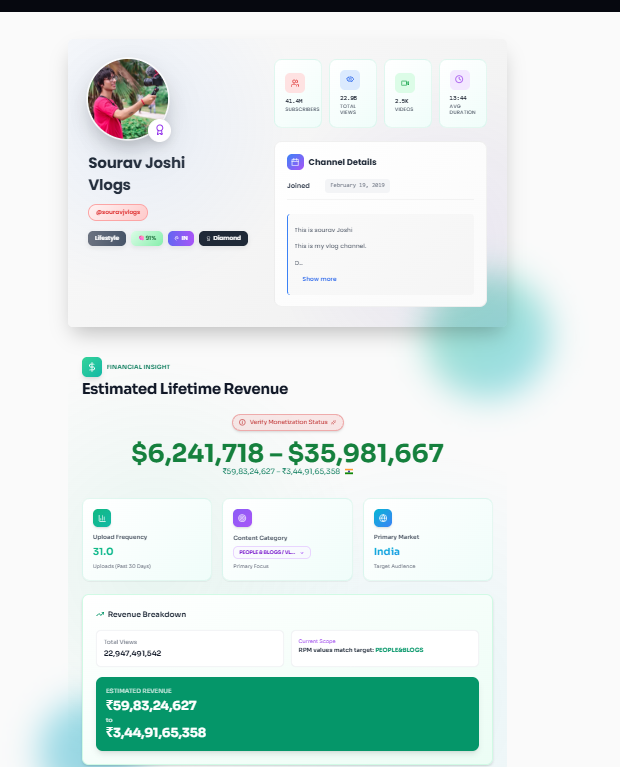
Here is my tool result for the Sourav Joshi Vlogs channel:
Common Myths About YouTube Revenue
Myth 1: One million views always earns the same amount
False. Different niches and audiences can produce very different RPMs.
Myth 2: Subscribers determine earnings
False. Views, monetization rate, audience location, and advertiser demand matter far more.
Myth 3: Shorts pay the same as long-form videos
False. Shorts follow a different revenue-sharing model and generally produce different RPM characteristics. (Google Help)
Myth 4: Every country has identical CPM
False. Advertising competition differs across markets.
How Should You Use YouTube Revenue Calculators Correctly?
Treat them as planning tools rather than exact income reports:
- Compare revenue ranges instead of exact numbers.
- Consider the creator's niche.
- Think about audience geography.
- Remember seasonal advertising changes.
- Compare several calculators instead of trusting only one.
- Validate assumptions using your own YouTube Analytics once monetized.
Tools and Practical Applications
Revenue calculators become more useful when combined with other YouTube research tools. A workflow I'd recommend:
- Use the YouTube Revenue Estimator to estimate advertising income.
- Run the YouTube Monetization Checker to verify monetization eligibility indicators.
- Analyze niche classification with the YouTube Category Predictor.
- Compare YouTube channels to benchmark competitors.
- Use a YouTube keyword extractor to identify future content opportunities.
Free alternatives include:
- YouTube Studio (for your own channel only)
- Google Trends
- Google Keyword Planner
What's Next?
Use revenue estimates to make better content decisions instead of chasing exact numbers. You can:
- Estimate your channel revenue using a transparent calculator.
- Compare different niches before creating new content.
- Learn more about RPM and CPM.
- Explore your own YouTube Analytics after monetization.
Suggested reading:
Conclusion
YouTube revenue calculators are educational tools—not income reports. Public calculators provide valuable insights into earning potential, but they cannot access private analytics, sponsorships, memberships, or every factor that shapes a creator's income. That's why the most trustworthy tools focus on transparent assumptions and realistic revenue ranges instead of promising impossible precision.
If you understand how these estimators work, you'll be better equipped to evaluate channels, compare niches, and set realistic expectations for your own YouTube journey.
Written by
Jayesh Mehta YouTuber with 5+ years of experience and founder of YTKits. Jayesh specializes in YouTube growth tools, creator analytics, monetization research, and AI-powered developer tools built to help creators make data-driven decisions.
Reviewed by
YTKits Editorial Team Specialists in YouTube analytics, SEO, creator monetization, and digital publishing.