So you finally got monetized. Congrats! You check YouTube Studio for the first time, excited to see your earnings, and... there are two numbers.
CPM: $4.50 RPM: $2.20
Wait, what? Why are there two different numbers? Which one is your "real" earnings? And why is one almost half of the other?
I've been on YouTube for over 5 years, and this confused me too when I first got monetized. Later, when I built the YTKits Revenue Estimator, I had to dig deep into how RPM and CPM actually work behind the scenes — because the tool needed to give creators accurate estimates based on their country, category, and video duration. Most revenue tools online just slap a single CPM number on everything, which is why their estimates are way off.
Let me clear this up once and for all, because YouTube's own explanations can be genuinely hard to follow.
The Simple Answer (Before We Get Technical)
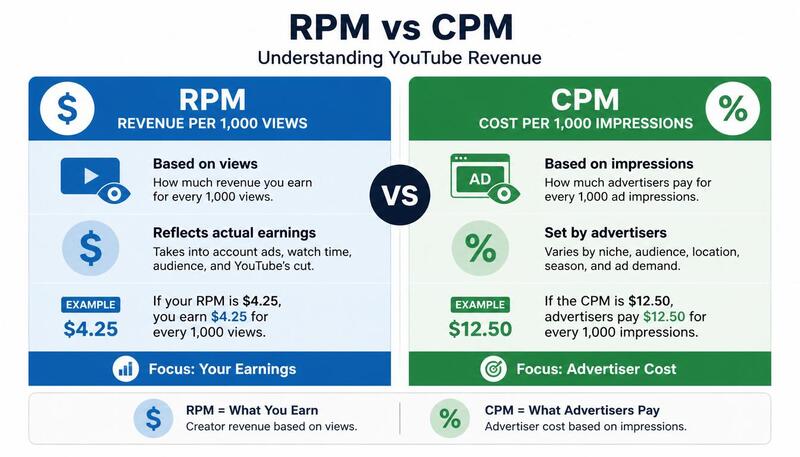
CPM = What advertisers pay RPM = What YOU actually get
That's it. That's the core difference. Everything else is just details.
CPM: The Number That Looks Better (But Doesn't Tell the Full Story)
CPM stands for "Cost Per Mille" (mille is Latin for thousand, because apparently YouTube likes to sound fancy).
It means: how much advertisers pay per 1,000 ad views.
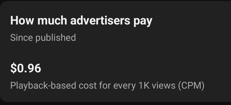 A real CPM reading from YouTube Studio — $0.96 per 1,000 views on this video.
Notice I said ad views, not video views. That's important.
Example:
Your video gets 10,000 views, but only 6,000 people actually saw ads (the rest used ad blockers or skipped). Your CPM is $5.
Math: 6,000 ad views = 6 "thousands" × $5 = $30 from advertisers.
Sounds good, right? But here's the catch: you don't get that $30.
RPM: The Number That Actually Matters
RPM stands for "Revenue Per Mille" (there's that fancy Latin again).
It means: how much YOU earn per 1,000 video views, after YouTube's share is taken out.
 The same channel's actual RPM — $0.30 per 1,000 views. Notice how much lower it is than the $0.96 CPM above.
Same example from above:
- 10,000 video views
- Advertisers paid $30 (CPM of $5 on 6,000 ad views)
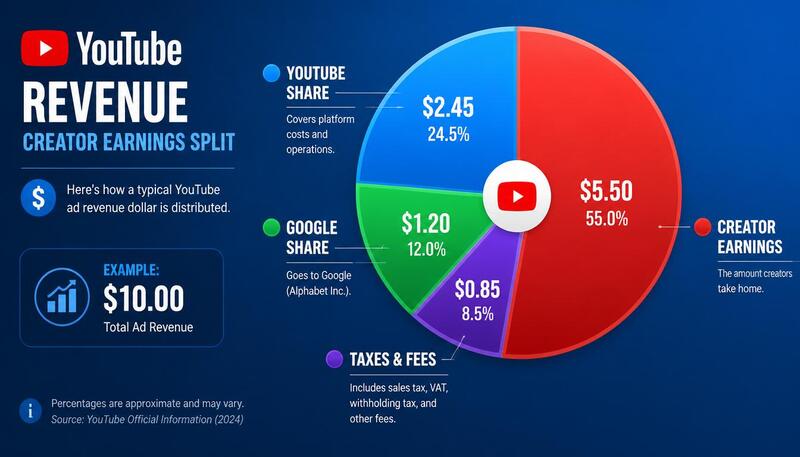
- YouTube's share on ad revenue is 45%, per YouTube's own Partner Program earnings page — so about $13.50 goes to YouTube
- You get: $16.50
- Your RPM: $16.50 ÷ 10 thousands = $1.65
See the difference? CPM was $5, but your actual RPM is $1.65.
This is why RPM is always lower than CPM. It accounts for:
- YouTube's share of ad revenue (45%, per their official split)
- Viewers who don't see ads (ad blockers, Premium subscribers)
- Ads that don't get clicked or viewed fully
Why YouTube Shows Both (And Why It's a Bit Annoying)
Good question. Here's my theory: CPM looks better, so creators feel good seeing it. But RPM is what you actually earn, so YouTube has to show that too.
CPM is useful for: comparing your channel to industry benchmarks (when people say "gaming channels have $8 CPMs," they mean CPM, not RPM).
RPM is useful for: actually knowing how much money you're making.
Most creators focus on CPM because it's the bigger, more flattering number. But RPM is the only one that maps to your bank account.
Typical RPM Ranges by Niche (Rough Estimates, Not Official Data)
I want to be upfront about something: the numbers below are my own rough estimates, based on patterns I've seen across my own channel, other creators, and general trends — not an official YouTube dataset or a peer-reviewed source. Your actual RPM will vary by audience, season, and channel specifics, so treat these as a general sense of direction rather than a guarantee.
Higher RPM niches (roughly $8-25):
- Finance / Investing
- Business / Entrepreneurship
- Tech reviews (expensive products)
- B2B / SaaS content
- Legal / Insurance
Mid-range RPM niches (roughly $3-8):
- Tech tutorials
- Productivity / Self-improvement
- Education / Online courses
- Health / Fitness
- Travel (depends heavily on audience location)
Lower RPM niches (roughly $1-3):
- Gaming
- Vlogging / Daily life
- Pranks / Comedy
- Music (covers/reactions)
- Kids content
Why the difference? Advertisers generally pay more to reach audiences who are actively spending money. Someone watching "Best Business Credit Cards" tends to be more valuable to advertisers than someone watching "Fortnite Funny Moments." It's not necessarily fair, but it's how ad demand works.
How This Plays Out in a Real Market: India
The ranges above are a rough global guide, but RPM varies enormously by country — and India is one of the largest creator markets on YouTube, so it's worth a closer look.
I put together a country-specific RPM breakdown for India while researching this topic, based on public creator earnings, monetization screenshots, creator interviews, and YouTube's own documentation. I go through the full 20-category table — plus how much video length alone changes RPM within each category — in YouTube Categories by RPM: Which Niches Pay the Most?. A few highlights from that data:
| Category | Country | Videos ≥ 8 Min | RPM Tier |
|---|---|---|---|
| Finance | India | $0.56 – $3.50 | Premium |
| Online Income | India | $0.45 – $3.08 | Premium |
| Science & Technology | India | $0.42 – $2.80 | High |
| Entertainment | India | $0.39 – $1.40 | Medium |
| Gaming | India | $0.22 – $0.65 | Moderate |
| ASMR | India | $0.17 – $0.64 | Low |
Two things stand out here that match the broader pattern in this article:
- Finance and Online Income sit well above every other category, roughly 4-5x higher than Gaming or ASMR at the same video length.
- Length matters a lot. Almost every category earns 2-6x more once a video crosses the 8-minute mark, since that's the threshold where mid-roll ads become available — the same mechanic I cover in the "make longer videos" section below.
Even the "high RPM" categories here earn modestly by India RPM standards compared to how the same categories perform in the US or UK — this reflects India-specific ad demand, not global rates.
How to Actually Increase Your RPM
Forget the clickbait "increase your CPM" videos. Here's what actually works.
1. Target Countries with Higher Ad Rates
Viewers from these countries tend to mean higher RPM:
- United States (highest)
- Canada
- United Kingdom
- Australia
- Germany
- Nordic countries
Viewers from lower ad-spend markets typically mean lower RPM — advertisers simply pay less to reach those audiences.
You can't fully control where your viewers come from, but you can influence it:
- Use English (reaches higher ad-spend markets)
- Reference US/UK-specific examples
- Cover topics relevant to those audiences
Check your audience geography in YouTube Analytics. If most of your viewers are from lower ad-spend countries, that alone can explain a lower RPM.
2. Make Longer Videos (But Only If People Watch Them)
More watch time generally means more ad placements, which generally means higher RPM.
A 15-minute video can carry 3-4 mid-roll ads. A 5-minute video might only fit one.
But — and this matters — only if people actually watch the whole thing. A 15-minute video where viewers leave after 3 minutes performs worse than a 5-minute video people watch in full.
Sweet spot for most channels: 8-12 minutes. Long enough for mid-rolls, short enough to keep retention healthy.
3. Be Careful with Sensitive or Controversial Topics
YouTube's advertiser-friendly guidelines are genuinely strict. Videos on certain topics get "limited ads," which can significantly reduce RPM.
Topics that often get demonetized or limited ads:
- Politics (any side)
- Tragedy / disasters
- Health crises
- Strong language early in the video
- Controversial social issues
I'm not saying don't make these videos — just know they'll typically earn less. A video that might otherwise get a $5 RPM can drop to $0.50 or lower under limited ads.
4. Turn On "All Ad Formats"
YouTube lets you choose which ad types run on your videos. Some creators turn off certain formats (like short bumper ads), assuming they're annoying to viewers.
That usually backfires. Fewer ad formats generally means fewer ads shown, which generally means lower RPM.
Unless a specific ad format is genuinely hurting viewer experience, keeping them all enabled tends to mean more ad inventory — and more potential earnings.
5. Target Higher-Value Topics Within Your Niche
Even within one niche, some topics simply pay more.
Gaming channel? "Best Gaming Laptop 2026" will likely earn several times more than "Funny Game Fails," because people watching laptop reviews may be about to spend $1,500 — and advertisers want that audience.
Cooking channel? "Best Kitchen Appliances" tends to outearn "Easy Pasta Recipe" for the same reason.
Think about what your viewers might buy after watching. That's what advertisers are actually paying to reach.
The Question Everyone Asks: "What's a Good RPM?"
It depends heavily on your niche, but here's my rough personal guide:
- $0-1: Something's likely off — check monetization status and audience geography
- $1-3: Normal for gaming, vlogging, entertainment
- $3-6: Good for most niches
- $6-10: Great — above average
- $10-20: Excellent — usually a high-value niche
- $20+: Rare, usually finance or business content
These bands are based on patterns I've observed, not an official benchmark — don't compare your RPM to creators in a completely different niche. A gaming channel earning $2 RPM might be doing great, while a finance channel earning $8 RPM might actually be underperforming for its niche.
RPM Varies More Than Most Creators Expect
Here's something a lot of creators don't realize: RPM can swing significantly month to month.
December often sees a spike (holiday shopping means advertisers spending more). January often dips right after (advertiser budgets reset or run dry).
I've personally seen channels go from a $6 RPM in December to $2.50 in January. That's a normal seasonal pattern, not a sign something's broken.
Your RPM in the first month or two after monetization can also look unusual while YouTube's ad-matching system is still learning your audience. Give it 2-3 months to settle before drawing conclusions.
Tools to Track Your Actual Earnings
Want to know how much you'll earn with your current views and RPM?
Use our Revenue Estimator — paste any channel URL and see estimated earnings based on typical RPM patterns.
Want to hit monetization faster? Check the Monetization Checker to see exactly how many more subs and watch hours you need.
The Bottom Line
Try not to over-focus on CPM alone — it's a flattering number, but it isn't the one that hits your bank account.
RPM is what actually matters.
Focus on:
- Making content that attracts higher-spending audiences
- Growing viewership from countries with stronger ad markets
- Keeping videos advertiser-friendly where possible
- Building watch time with longer, genuinely engaging videos
And remember: a "low" RPM channel with 1 million monthly views will typically out-earn a "high" RPM channel with 10,000 views.
Views × RPM = Money
Both numbers matter. Don't chase views while ignoring RPM, and don't chase RPM while ignoring views — find the balance between them.
Related Tools
- Category Checker — Optimize your video category for better ad placement
- Keywords Extractor — Analyze titles, tags and metadata from any public YouTube video.