YouTube Copyright Claims: How to Avoid Them (And Not Lose Your Mind When One Hits)
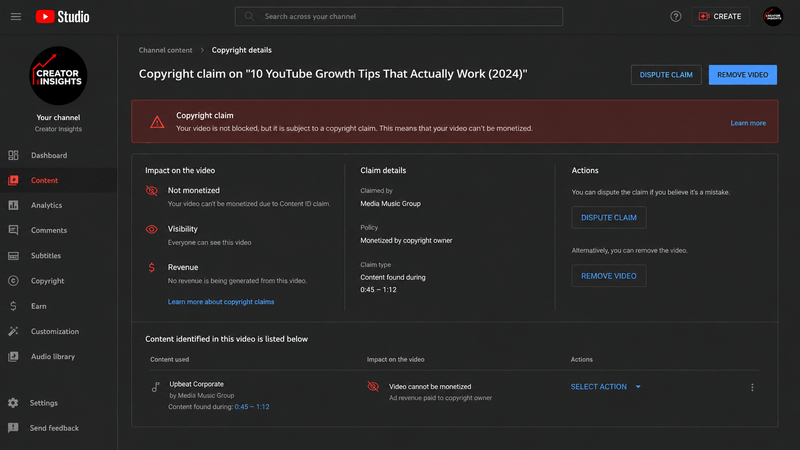
The first time I got a copyright claim, I was honestly about to delete the video.
I'd uploaded a vlog. Background had music playing from my Spotify. Got the email maybe 12 hours later. "A copyright claim has been made on your video." My stomach dropped. Started Googling like crazy. Was my channel about to get deleted? Was monetization gone? Did I just blow everything?
Turns out no. Most copyright claims are NOT the end of the world. But you absolutely need to understand how this works because the wrong move (or no move) can cost you real money or your channel.
Here's the clear-headed breakdown I wish someone had given me at 1 AM that night.
First, Know What You're Actually Dealing With
Most creators mix these two up and panic at the wrong thing. They are completely different.
A Content ID claim is automatic. A bot scanned your video and matched something to a copyrighted database entry. Not a strike. Doesn't risk your channel. Usually just redirects ad revenue to the copyright owner. You can dispute it.
A copyright strike is when an actual human (or legal team) manually filed a takedown against you. This goes on your record. Three strikes and your channel is gone. Strikes expire 90 days after you complete copyright school. Way harder to dispute.
If you got an automated email saying "claim" — breathe. You're fine. If you got a strike, that's when you need to actually be careful about what you do next.
What Triggers Most Claims
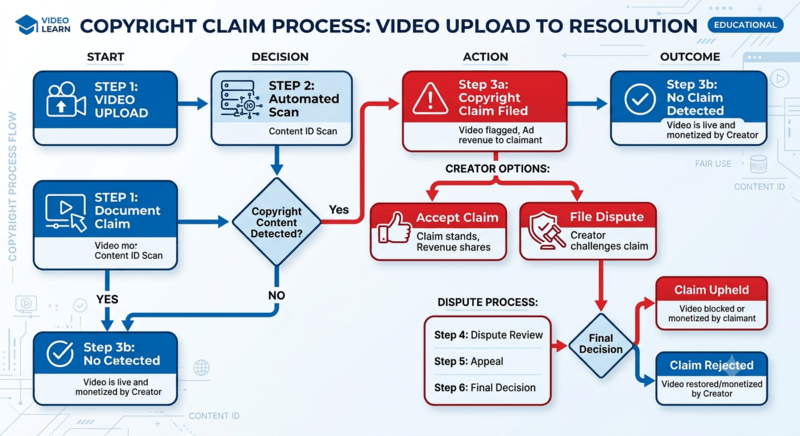
How Content ID claims work from video upload to final resolution
Content ID scans every upload against a huge database of copyrighted music, video, audio, etc. The big offenders:
Music. This is like 80% of claims. Any commercial music. Even a few seconds. Even quiet in the background. Even when it's playing from someone else's speakers across the room. Even your own playlist running while you film. Content ID catches all of it.
Movie and TV clips. Same logic. A few seconds is enough. Streaming something on a second monitor in the background of your video? Claim incoming.
Video game music and cutscenes. Game music is often licensed separately from the game itself. Showing cutscenes can claim you for the music inside them. Some games are notorious — Nintendo for one.
Other creators' footage. Using clips from other YouTubers. Even short. Even with credit. Credit doesn't grant permission.
Stock footage you didn't really license. A lot of "free" stock sites have hidden licensing terms. The footage felt free when you grabbed it. The claim two months later disagrees.
"Royalty-free" music that wasn't actually royalty-free. This one stings. Some YouTube channels post "free music for creators" but the underlying license is shaky. Always check the actual terms.
What Triggers Strikes (The Serious Stuff)
Strikes are filed by humans, not bots. They happen when:
- You uploaded content the owner specifically wants down
- You re-uploaded protected content without permission
- You ignored or fought a Content ID claim and the owner decided to escalate
- Your fair use defense isn't airtight and the owner pushed back
The difference: claims are automatic, strikes are intentional. If someone is actually going after you with a strike, they want the content gone, period.
The Fair Use Trap
This is where so many creators get themselves in trouble. The internet is full of really bad advice about "fair use."
Let me clear up the actual rules:
Fair use is a US legal doctrine, not a YouTube setting you can toggle.
"I gave credit" is not fair use.
"I only used 10 seconds" is not automatically fair use. The Beastie Boys actually lost a music sampling case over 6 seconds.
"It's for educational purposes" is not a free pass.
"I'm doing commentary" only works if you're actually transforming the content meaningfully. Adding a reaction face in the corner doesn't count.
What courts actually look at when deciding fair use:
How much you transformed the work (real commentary or analysis vs just replaying it).
Whether the original is factual or creative.
How much you used relative to the whole.
Whether your use hurts the owner's ability to make money from their work.
Honest take: unless you're running a serious commentary or news channel making genuinely transformative content, don't bet your channel on fair use. License things properly or use truly free alternatives. The legal grey zone is not a safe place to live.
How to Bulletproof Your Channel
Proper licensing and prevention strategies keep your channel safe
The good news: avoiding most copyright nonsense is straightforward if you set up correctly from the start.
Use actually-royalty-free music. YouTube Audio Library is free and built into Studio. Epidemic Sound, Artlist, Soundstripe are paid but solid. These actually clear claims. Random "free music" YouTube channels usually don't.
Make your own music. Even basic free DAW stuff. Original = no claim ever.
Don't film with music playing. Turn off Spotify. Turn off the radio. Turn off the TV. Background music is the #1 source of completely unnecessary claims and the easiest to avoid.
License stock footage from real sources. Pexels and Pixabay have legitimately free options. Adobe Stock, Shutterstock, Storyblocks for paid. Skip the random "free clips" sites.
Avoid movie and TV clips entirely if you can. If you really need them for review, keep it under 5 seconds, add clear commentary on top, and accept that you might still get claimed anyway.
Be careful with game streams. Some game soundtracks claim. Some don't. Look up your specific game's copyright policy before uploading streams or compilations. Nintendo will absolutely come for you.
Read the license on every free asset. Especially anything from random "free music for YouTube" channels. The hidden gotchas are real and they catch up to you eventually.
What to Do When a Content ID Claim Hits
Got the email. Here's the actual playbook:
Don't panic. Worth repeating. Not a strike. Your channel is fine.
Read what was claimed. The email tells you exactly what was matched and at what timestamps. Look at it before doing anything.
Decide your move based on whether the claim is legit.
If you really did use copyrighted material:
- Accept the claim. Revenue goes to the owner. Your video stays up. Channel is fine. Move on.
- Or edit it out using YouTube's built-in tools. Remove or replace the claimed audio. The claim disappears automatically.
If the claim is wrong (false positive, you had a license, real fair use):
- Dispute it. YouTube reviews. The claimant can either accept your dispute or escalate. If they escalate and you're wrong, you risk a strike. Don't dispute unless you're genuinely confident.
For monetization-critical videos blowing up, fix it fast. Every hour costs you real money. Either accept (if it's minor) or remove the claimed content immediately so monetization comes back to you.
What to Do When You Get a Strike
Different game. Be careful.
Read the strike carefully. Who filed it? What content? When?
Don't dispute reflexively. Disputing a legitimate strike with a weak defense can escalate to actual DMCA legal proceedings. That's not a hypothetical, it does happen.
If it's a one-off and the strike was legitimate, just wait it out. Strikes expire 90 days after you complete YouTube's copyright school (quick, online, free). One strike doesn't kill you.
If the claimant was wrong and you have a real defense, you can file a counter-notification. This goes through formal DMCA process. The claimant has 10-14 days to either drop it or take you to court. Most won't take it to court unless big money is involved.
If you've got multiple strikes or you're approaching three, talk to a media lawyer. Real one. There are some who specialize in YouTube cases. At that point a misstep can cost you the whole channel and it's worth a couple hundred dollars in consultation fees.
Myths That Get Creators in Trouble
"If I credit the creator, it's fine." Wrong. Credit doesn't grant license.
"Under 10 seconds is fair use." Wrong. No magic time threshold exists.
"YouTube doesn't really go after creators." YouTube doesn't. Copyright owners do, and they have automated tools that scan every upload on the platform.
"If it's online, it's free to use." Wrong. Everything is copyrighted by default unless explicitly released otherwise.
"My monetization is safe because I was monetized before." Wrong. Once a claim hits a video, revenue from that video redirects to the claimant. Doesn't matter that you were monetized last month.
What I Actually Do Now
Real talk: I pay for Epidemic Sound at like $20 a month. It's pocket change compared to even one viral video's worth of revenue being claimed.
If you're making any meaningful YouTube revenue, the cost of a real music subscription is dramatically less than the revenue lost to a single claimed banger video. The math is obvious.
If you're early and not making revenue yet, use YouTube Audio Library exclusively. Free, safe, decent quality. Boring but boring is good when you're starting out.
Track your channel's monetization health with the Monetization Checker so you can spot claim issues across multiple videos quickly.
The Bottom Line
Copyright on YouTube is not as scary as it feels at 1 AM when you're staring at your first claim email.
Most claims are automatic, mild, and easily resolved by either accepting or editing the offending content out. Strikes are more serious but still recoverable if you handle them carefully and don't dispute reflexively.
The real defense is upstream — use properly licensed music, don't film with copyrighted audio playing in the background, license your stock footage from real sources, and don't rely on fair use unless you actually understand it.
Get this right once and you'll basically never deal with copyright issues again. I haven't had a claim in over a year and it's entirely because I stopped doing the things that cause them.
Related Tools
- Monetization Checker - Track monetization status and spot issues across videos
- Revenue Estimator - See potential revenue impact of claims
- Category Checker - Make sure your video category reflects original content
- Keywords Extractor - Research how original creators in your niche position content